

It's a new world
Your typical conservative is pointing at us Democrats right about now and saying, "Yeah, I told you so. You liberals who believe in an entitlement society have got it all wrong." More than any other of the lies told about us, this one makes me tear my hair out! Democrats do not believe in an entitlement society! No one would be more thrilled than me if that single mother out there had the tools to provide food, clothing, shelter and medical care for her children without government assistance.
The difference is in the best way to get there. Conservative philosophy seems to be pretty simple; everyone's on his own.
Democrats have a different view. I am currently enrolled in a class on the Toyota Production System at work. One characteristic of the coursework is you get to learn a bunch of Japanese words. One of these is "nemawashi". It's the word for properly preparing the soil to plant a tree. The tree won't grow if you don't prepare the soil. The application of this principle in the business world is obvious, but in our changing society, it especially applies to people. We can't expect those being left behind by our new economy to grow and thrive without some soil preparation. If you just plunk them down in the dirt, they will perish just as surely as all those trees I've tried to plant out in the crappy, alkaline soil in Plain City.
So, back to Friedman's column: "I find a lot of this scary. We’re entering a world that increasingly rewards individual aspiration and persistence and can measure precisely who is contributing and who is not. This is not going away, so we better think how we help every citizen benefit from it.
It has to start, argues Ryan Burke, the director of jobs and workforce for Hope Street, with changing our education-to-work system to one that enables and credits a variety of viable pathways to needed skills. But for students and workers to take advantage of the opportunities open to them in a 'defined contribution’ world, they will need much better information to inform their decisions. Right now it’s much easier to evaluate a choice about buying a car or picking a mutual fund than to find the competencies employers are looking for and the best cost-effective way to obtain them."
This isn't going to be easy. It will take work and creativity, Which means simplistic answers won't do. One final quote, from Friedman's book Hot, Flat and Crowded: "There was a lot about Reagan's economic policies that made sense when it was first introduced. We did need to unlock talent, energy and entrepreneurship that had been bottled up in our economy. But like all good things in politics, for everything there is a season and limits. Reaganism, which coincided with the collapse of America's mortal enemy, the Soviet Union, ushered in a period of history in which more and more public officials denigrated government and offered painless bromides for prosperity. The market was always right. Government was always wrong. And any government proposal that involved asking the American people to do something difficult - to save more, drive more fuel-efficient cars, study harder, or to be better parents - was 'off the table'. You could not utter such phrases and expect to be elected to any high office in America."
The time for those "painless bromides" are past. They won't work. It will take a lot of effort and sacrifice to prepare the soil in America so all her citizens can be self-sufficient and prosper in the new economy.

The Constitution Hangs by a Thread
"You will see the Constitution of the United States almost destroyed. It will hang like a thread as fine as a silk fiber.... I love the Constitution; it was made by the inspiration of God; and it will be preserved and saved…” – Attributed to Joseph Smith, May 1843
Across congregations of the Mormon Church the above quote has become a rallying cry among the conservative members. I have been approached by several wanting to discuss the destructive nature of the Constitution by our current administration. “Today the constitution hangs by a thread,” always concludes each episode as the definitive reason for their political posturing. Stepping aside from the fact that the bloody Civil War was on the horizon in 1843, which truly challenged the foundation of the Constitution, there is merit to this quote today.
The Framers designed the Constitution to equalize representative power across the states, strengthen the voice of the minority, and drive equality. The Senate functions as a contained democracy using majority rule, with equal representation across the states regardless of population. The House is designed to represent the people, equalizing votes across the collective population of our country. The House Representatives are “of the people” with short two year terms to align with the changing demands of the constituents they represent. The Framers designed our government with an inspired balance of power, representing the minority to a point, and using the legislative branch as a check for executive power.
Two changes in rules and actions threaten the balance of the Legislative Branch and the Constitution today. The filibuster changes the entire intent of the Senate and gerrymandering has removed the representative equality of the House. Our government has moved to an extreme representation of the minority which suffocates the will of the majority. In the Senate, Senators representing a mere 20 percent of the population can stop legislation and bring the chamber to a crawl. In the House, a populous minority retains control and abuses their influence to table popular legislation and misdirect funding.
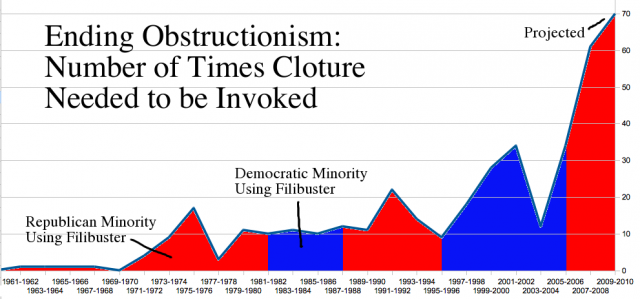 The Senate filibuster is not found in the Constitution and was first used in 1837 exploiting a change in debating rules made in 1806. The filibuster was used just a handful of times until 1970, and as a last resort. Today it is part of the process on almost every bill or appointment. What the Framers intended to be a simple majority in the Senate has now become a 60 vote super-majority. Couple this with the already imperfect representative balance of the Senate, and it is easy to understand why gridlock has ensued.
Today Republicans use the filibuster to oppose legislation and bring the legislative process to a crawl. There have been several bills these past four years, that after receiving the 60 votes needed to end the filibuster, passed 99-0. One of the most egregious examples came last December when Republican Minority Leader Mitch McConnell filibustered his own bill wasting time and tax payer resources. The real problem with this obtuse Senate rule is 40 minority Senators can represent less than 20 percent of the US population. Eliminating the use of the filibuster still meets the intent of minority representation as 45 Republican Senators represent 30 percent of the population.
On the other side of the Legislative Branch the House has deviated from Constitutional intent due to progressive gerrymandering by Republican governors. As the majority of the states were controlled by Republicans after the 2010 census, a $30 million dollar redistricting action plan was executed further skewing the House’s representative characteristics. In 2012 there were 1.5 million more votes for Democrats yet there are 33 more Republican Representatives in the House. The US is 64 percent white but 4 percent of Republican Congressman are minorities. 51 percent of the population are women but only 8 percent of Republican Representatives. The abuse of redistricting is so widespread I see little chance of overturning House control even with a healthy voting majority in the near future.
Between the House and Senate actions by the minority party it’s easy to understand why the Constitution is being tread on. The American government has been hijacked by a party that relies on abusing rules and redistricting to push an unpopular agenda. Legislation like firearm background checks and immigration reform should be a slam dunk given the overwhelming support by the majority of the people, but the government has failed to perform even the most mundane functions. The Constitution is crippled and the balance of power upset because the minority party does not respect the Framer’s intent.
In Mormon congregations across the country my Republican friends are correct; Joseph Smith’s quote is just as applicable today as it was at the time of the Civil War. The Constitution hangs by a thread and they are the ones holding the scissors.

May 09, 2013
Mitt Romney at the Science Fair
Yesterday I read something from a Republican that made a lot of sense in explaining Romney’s recent loss. Representative Pete Sessions explained:
“Mitt Romney appeared like a kid who showed up for his science project and the teacher said, ‘Explain it,’ and Mitt couldn’t do it. His ‘dad,’ Paul Ryan, explained it to him, but Mitt didn’t get it. … That’s why we lost the last election.”
Now with all due respect to Representative Sessions for coming up with his science analogy, Paul Ryan is not Mitt’s dad. George Romney is. Mitt was trying to follow his dad’s footsteps running for President driven through public service and some vindication for his father. Mitt outpaced his father by winning his party’s nomination which his dad had failed to do. George’s presidential failure came after his statement about “brainwashing” by generals in Vietnam, who tried hard to convince him that the war was winnable. It wasn’t a winning position for the senior Romney and he lost to Nixon.
Mitt did seem like a kid at a Science Fair, however, whose dad (George, not Ryan) had groomed him for public service, but somehow Mitt never understood his father’s core direction. This might sound harsh, but how does one explain his conversion from a moderate Republican into the neo-con, tea-party disciple that didn’t fit the George Romney mantra? His flawed strategy peaked in the first debate but was flooded with inconsistencies as the election moved forward.
History – and maybe me – can be a harsh judge. Eventually the Republicans will figure out who they are and understand the pivotal middle ground. In the meantime, it is refreshing to have them talking about science.

May 03, 2013
Background Checks Work
 Recently the US Senate fell short of passing the most reasonable gun control measure ever brought to the Congressional floor by six votes (54 votes -- just a few shy of blocking a filibuster). The legislation was centered on closing background check loopholes involving private sellers at gun shows and through online sales. The legislation would not create a national registry of gun owners (although this was the main point of the disinformation campaign of the NRA), nor did it ban any specific weapon or magazines. The legislation was written by a bi-partisan senatorial duo, Republican Pat Toomey and Democrat Joe Manchin, and was supported by 85%-90% of American citizens according to every major poll.
Currently there is a background check system in place that is used by all licensed sellers. In the past year there were 150,000 firearm applicants denied. Since 1994 a staggering 1.9 million applicants have been rejected. These applicants were denied because of mental illness, criminal record, drug usage, illegal alien status, domestic abuse, and various other reasons. Even more telling, only 1% of all firearm rejections are ever appealed; revealing the applicant always complied with the verdict.
Even in the face of such overwhelming data I have heard opinions from several friends that background checks do not work, and a criminal will find a way to purchase a gun regardless of laws. This same type of argument was used against The Brady Bill in 1994 in regards to waiting periods. President Ronald Reagan responded “Critics claim that ‘waiting period’ legislation in the states that have it doesn't work, that criminals just go to nearby states that lack such laws to buy their weapons. True enough, and all the more reason to have a Federal law that fills the gaps.” Background check legislation, like the Brady Bill legislation, is designed to “fill the gaps."
It appears that Congress has fallen for the faulty logic of the opposition. While I agree with critics that motivated criminals will find ways around laws, they will have a tougher time navigating market dynamics. If background checks prohibit a single purchase, the price of firearms will rise for those unable to go through licensed sellers. A criminal will have to find a different way to acquire a weapon than from an online seller or an unlicensed dealer at a gun show. Expanding background checks will also facilitate responsible sales between family, friends, and acquaintances. These constraints on the supply will have negative pressure on price, and increase the risk of a potential gun buyer being caught through illicit acquisition.
If opponents to background check legislation believe that any such law is inefficient and impacts our second amendment rights, would they be willing to support a total repeal of all background checks? Highly unlikely. Why? Because opposing this legislation has little to do with the implied efficacy of the law or the second amendment, and more to do with political ideology. Background check legislation died with the divisive spirit of our representatives, who would rather shoot themselves in the foot than shake hands in the center.
April 28, 2013
Comparing Republican and Democratic Platforms to the LDS Church Position on Abortion
My friend and legislative colleague, Representative David Lifferth, and I have been discussing which political party's position on abortion is closer to the LDS Church's position. I say the Democratic platform and David says it's the GOP's. You can see Rep. Lifferth's last statement in our discussion at: http://davidlifferth.ning.com/profiles/blogs/comparison-of-abortion-platforms-of-republican-party-groups. This is my response.
First, let's summarize the LDS Church position on abortion. The Church makes clear that the circumstances under which an abortion is permissible from a religious and moral perspective are unusual. It condemns abortion for "personal or social convenience . . .." Unusual circumstances that may justify an abortion are when:
• Pregnancy results from rape or incest, or
• A competent physician determines that the life or health of the mother is in serious jeopardy, or
• A competent physician determines that the fetus has severe defects that will not allow the baby to survive beyond birth.
Even if one of these circumstances exist, abortion, " . . . should be considered only after the persons involved have consulted with their local church leaders and feel through personal prayer that their decision is correct." In addition, "the Church has not favored or opposed legislative proposals or public demonstrations concerning abortion."
The Utah State and Utah County GOP platforms are a bit different from each other on abortion. The state GOP position implies that all abortions other than those necessary to preserve the life of the mother or for pregnancies arising out of rape and incest should be criminalized. On the other hand, the Utah County GOP platform explicitly states that abortion should be illegal except " . . . where the life of the mother is at serious risk, or the pregnancy is the result of rape or incest." Both the Utah State and the Utah County GOP platforms would criminalize abortion even where the fetus has severe defects that will not allow it to survive beyond birth. This deviates materially from LDS Church teachings.
The national GOP platform deviates even more from Church teachings by creating greater restrictions than either the Utah State or Utah County GOP platforms. It explicitly supports a human life amendment to the Constitution to place a fetus's right to life from conception on a par with the life of the mother. The national GOP platform criminalizes all abortions without exception. The Church's position simply cannot be reconciled with the national GOP platform.
The national Democratic platform supports Roe v. Wade and a woman's right to choose as framed by that decision. Contrary to how many pro-life advocates characterize it, the national Democratic platform does not call for supporting abortion rights at all stages of pregnancy. It emphasizes that abortion is an intensely personal decision between a woman, her family, her doctor and her clergy.
The GOP platforms at all levels impliedly or expressly call for abortion to either be made illegal across the board or illegal subject to narrow exceptions. Part of the moral or religious basis for the national GOP position is that life begins at conception. Of course, believing that life begins at conception is not a prerequisite for believing that all abortions should be prohibited or for promoting a Constitutional amendment recognizing personhood at conception. But if you believe life begins at conception it provides the factual and moral foundation for the legal conclusion that the fetus has just as much a right to life as the mother.
In fact, the LDS Church, unlike the Catholic and some other religions, has never specifically identified the point at which life begins. The range of answers to that question from various LDS Church leaders goes all the way from conception to the point at which a newly born baby takes its first breath. A Church member may, as a personal matter, choose to believe that life begins at conception. But, to the extent they think about it at all, an LDS Church member could also be justified in believing that life begins when the fetal heartbeat begins, or when movement begins in utero, or when the fetus becomes self-sustaining outside the womb, or when a baby draws its first breath. As with many other doctrinal points within the LDS Church, the matter is theologically unsettled. As such, there is simply no definitive LDS Church statement to support the position taken by the national Republican platform that life begins at conception as opposed to some other point later in the developmental process of a fetus.
Rep. Lifferth points out that the LDS Church and the GOP positions are similar in that they both denounce abortion. It is true that both do agree that certain types of abortion should be prohibited under either law (GOP) or are not in accordance with church teachings (LDS). But Democrats have not come out in favor of unlimited access to abortion. They simply support Roe v. Wade and oppose any limits on a woman's choice that go beyond that case. No one disputes that both federal and state law impose significant restrictions and criminal punishment on many types of abortion that do not fall within Roe v. Wade. So the LDS Church, Republicans, and Democrats all agree on that.
Rep. Lifferth states that the LDS Church and GOP positions are similar in using terms such as "sacred" and "sanctity" when referring to the unborn child while the Democratic platform does not use such terms. But this similarity doesn't really help Republicans demonstrate that the GOP is closer than the Democrats to the LDS Church position on abortion. It just shows that on this, as on so many other issues, the GOP frames political debates in religious terms as often as possible. Is that a helpful or productive thing in terms of advancing understanding about what would be good public policy? I don't believe so. Decisions about public policy should be based on facts, not ideology or a particular religion's moral values. Nothing about LDS Church doctrine advocates fusing church and state policymaking based solely on religious or moral principles. In fact, both generally and in the context of the abortion debate, the Church supports the First Amendment and long-standing Constitutional doctrines about the need to separate church from state in our political affairs.
Rep. Lifferth goes on to state, "the LDS Church position is that 'elective' is contrary to the will and the commandments of God. This is a direct contradiction of the National Democratic Party's position which states [that it] "strongly and unequivocally supports . . . a woman's right to make decisions." Rep. Lifferth suggests that the LDS Church would support efforts to see its position on abortion channeled directly into civil and criminal law. But the Church says no such thing. In fact, it expressly states that it does not favor or oppose legislative proposals involving abortion. In other words, the Church explicitly recognizes the importance of separating church and state. Rep. Lifferth's statement inaccurately and improperly attempts to combine the two.
It's the Church that makes the right call on this point. The position of the GOP and Rep. Lifferth, advocating that certain conduct be made a crime on the basis that it is proscribed by religious or moral principles, is contrary to LDS Church doctrine. The Democratic platform is more in line with the Church's position because the Democratic platform does not frame the debate in religious terms and it does not insist that because particular conduct is deemed "immoral" by a particular religion that is must be criminalized. The LDS Church position is that its moral teachings do not reach to the political sphere and that its religious position does not dictate public policy.
Rep. Lifferth concludes by stating: "there is nothing in the LDS Church's position on abortion that supports 'Roe v. Wade' or a woman's right to an 'abortion'. On the contrary, none of the 'exceptional circumstances' listed 'automatically justify and [sic] abortion." True. But it is likewise true that nothing in the LDS Church's position on abortion advocates for the reversal of Roe v. Wade or a woman's legal right to an abortion. In fact, as noted above, the Church specifically differentiates between the two.
The idea that a particular religion's spiritual tenets should not necessarily be adopted as public policy is something we, as Utah legislators, understand very well and accept in other contexts. For example, tobacco use is strongly and unequivocally forbidden by LDS Church doctrine. Church teachings proscribing tobacco are more clear-cut than its statements about abortion. Yet there is no thought by the Utah State legislature of criminalizing tobacco use. Why not?
I believe at least part of the reason is that most people recognize that there would be enormous practical problems with trying to make all tobacco use illegal in Utah. Doing so would require the commitment of significant resources to enforce the law. What effect would criminalizing such fundamentally personal and private behavior have on our law enforcement resources, our personal relationships, our community relations, the public image of the state, efforts to bring economic development to Utah, tourism, etc? In addition, legislators are, and should be, wary of using coercive government influence to regulate personal and private choices of individuals. This is true even if everyone recognizes those choices may, directly and indirectly, kill and seriously injure the person who engages in the conduct and bystanders as well. Why do we not consider and discuss the same types of, cultural, social, economic, logistical, political, and philosophical factors when it comes to abortion? These issues are no less prominent, valid, and difficult with regard to abortion than with tobacco, alcohol, or a host of other behaviors arising out of personal choices the Church prohibits or deems immoral.
The problem with the abortion debate is that it has come down to two sides simply yelling slogans and platitudes at each other. The real world effects of going in the direction that the national or state GOP wants to take us are rarely discussed. If those realities and the effects of banning all abortions as the GOP platforms call for were considered in any detail, I'm very confident more Utahns would support the Democratic than the Republican position on abortion.
The Primary Concern
The primary election process is the greatest cancer on our political landscape. They have become a moral issue, driving politicians to make choices based on survival instead of reasonable policy and personal conviction. Primaries have driven moderate thinking out of the mainstream, and created an environment where compromise is the new four letter word. Primaries are the breeding ground for ideologues who pander relentlessly to the small selection of voters showing up to the preliminary polls. The primary system trades strong candidates for weak ones, swaps reasonability with extremism, and switches compatibility for hostility.
Although both parties are faced with the primary gauntlet, the Republican Party seems to be disproportionately impacted. Over the last two elections Republicans have given up potential control of the Senate, two presidencies, and the potential ousting of Majority Leader Harry Reid due to Tea Party meddling. There have been five different Senate seats that have either flipped or maintained Democrat control due to weaker Republican candidates beating stronger, more electable, Republican candidates in the primaries. For example, in the race for the presidency, both McCain and Romney had to move away from their moderate rhetoric seeking party election, which crippled their electability in the general election. Romney specifically moved from a being a “compromising moderate” to "severely conservative".
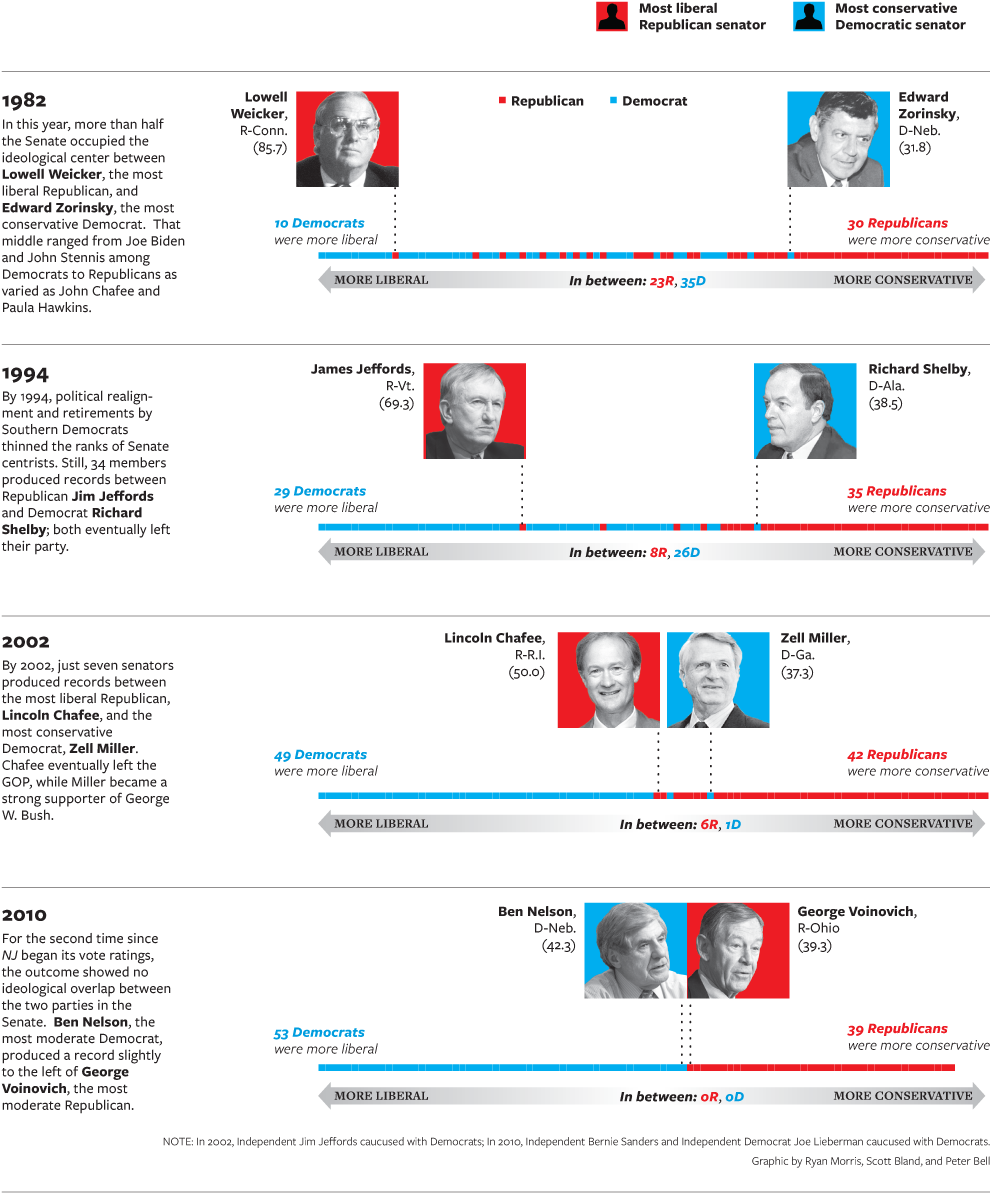 The Media National Journal has tracked conservative and liberal members across parties for several decades. In 1982 the Senate had significant overlap in their political leaning. The eleventh most liberal member of the chamber was a Republican, Lowell Weicker. The thirty-first most conservative member of the chamber was a Democrat, Edward Zorinsky. In between these two men fell fifty-eight Democrats and Republicans, each committed to their party and to their constituents. The House of Representatives shared a very similar markup, with over 60% of the members falling between the most conservative Democrat and the most liberal Republican. It was under this environment that President Reagan found significant compromise with Speaker Tip O’Neill passing tax laws and social reform.
Today there is significant polarization in political representation which accentuates gridlock and divides government. Political representatives know that any give and take will be fodder for the next primary, and grounds for unemployment. One idea to cure Washington’s curious dysfunctional behavior is opening up primary elections to independents. We should also consider California’s primary system where the top two vote-getters run against each other in the general election. Whatever the solution, we voters need to line up at the polls in the summer like we do in the fall. We need to elect candidates that will be reasonable and thoughtful government representatives, beholden only to those that elected them, rather than a proscribed ideology.
April 16, 2013
April: Jesus is my Example

April
Family Home Evening: Jesus is my Example
John 8:12 “I am the light of the world: he that followeth me shall not walk in darkness, but shall have the light of life.”
Suggested Song: Teach Me to Walk in the Light (Hymn 304, CS p. 177)
What is an Example?
Play “Do as I do”. Each member of the family takes a turn as leader. The leader stands in front of the others and performs an action, like clapping, touching his nose, winking, or saying something. The rest of the group imitates his actions. Parents or the ones conducting the family home evening may want to be leader after the others have had a turn so they can introduce a few examples of reverent behavior for others to follow.
Discuss the idea of using Jesus as our example.
- Mark 10: 13-16 He loved the little children
- Mark 6: 53-56, 7:31-35 He helped the sick and those in need
- John 4: 6-10 He was kind
- John 8: 32 He taught the importance of truth
For the teenagers and adults:
“Inasmuch as ye have done it unto one of the least of these,”
Roger sat at the dinner table, tired but happy. He had spent his entire Saturday at the university library studying for exams. His roommates had all gone out on dates or to the football game, but Roger stayed in, determined to keep his high grade point average. He had finally finished all his studies, and was beginning to prepare his Gospel Doctrine lesson about following the example of Christ for the next morning.
When the doorbell rang, Roger reacted with a frown. “Who would be coming here on a Saturday night?”
When he opened the door he found an unshaven, scraggly dressed man about forty years old. The man’s breath smelled of tobacco and liquor. “I just drove into town,” the man said, “and my car stopped right here in the middle of your street.” The man explained how he hadn't eaten all day and that his friend had a son attending the university whom he wanted to find. “Could you spare me a bite to eat, and then help me find out what’s wrong with my car? You could probably help me find my friend’s son too, couldn't you?”
Roger tried to think of an excuse. There were several other houses on the street in which families, not students, lived. They probably had more food. They probably didn't have to worry about teaching a Sunday School lessons and weren't as tired as he was tonight. Besides, this guy might even ask to stay the night. What would his roommates think if they came home to this man in their apartment?
On the other hand…Roger did know something about cars…
- What would you do if you were Roger?
- What would the Lord have you do? Why?
- Read Matthew 25: 31-46 and discuss.
Challenge: Find ways to care for others in the next week. Write them down and discuss them. What can we do to help those we don’t see every day? What good can we do to help those we may never meet?
How To Be Anxiously Engaged (Part 3)
See Hannah's original post here, and my follow-up post after the election here.
The question of "what do we do now?" is ever before us. Now that the election is over, and the legislative battles in DC seem much more complex, confusing and obtuse, do we now dissolve back into the every-day of our lives? I believe that Latter-day Saints who support liberal politics or the Democratic party have a unique opportunity to express their views and to accomplish much good in changing the tone of politics in the nation and in our church. However, we often are not sure of what to do next --
For those hoping to maintain the momentum from this last election, please take a look into LDS Democrats of America as they expand into a national organization.
Please see this article in the Salt Lake Tribune.
Also, please explore their website here.
LDS Democrats of America offers us a way to get involved. Of course, let's continue to show our support for progressive causes through our daily actions, charitable giving, and our Mormons for Obama bumper stickers, but also let's look forward to real ways to get involved in the political process and express our collective Mormon voices! Click on the "Join Us" tab on the LDS Dems website to get involved!
Why I support the Affordable Care Act
As an LDS Democrat I support the Affordable Care Act (ACA). Here are my reasons:
1. It is the law of the land, duly passed by Congress, signed by the President, and upheld by the Supreme Court. As such I think Utah should participate. There is “no need to break the law of the land" (D&C 58:21).
2. People need access to healthcare, even if they are poor. Healthcare is expensive, so if we can help millions of people get care we should. I believe in helping people who are in need.
Some people say it will be too expensive. Congress doesn’t think so. It is yet to be seen. Let’s make sure we do all we can to help as many people possible in a fiscally responsible way.
Some people say it takes away agency by "forcing" people to pay more taxes. Our government is representative. When you are out voted it may feel that you are being forced to do something you don’t want to do. I can’t tell you how many times I’ve felt that way. But, “[I] believe in being subject to kings, presidents, rulers, and magistrates, in obeying, honoring, and sustaining the law.” (12th Article of Faith) Thankfully, we have civil means whereby we can challenge, and even change, laws. If we can’t do that we have the freedom to leave, not as states, but as individuals. Let’s consider everyone’s point of view and improve the ACA to address our concerns.
One thing I think should be changed is obliging people to adhere to the law by going against their religion. I believe in freedom of religion. I think we can make sufficient changes so religious-sponsored health institutions are comfortable participating in this new way of doing things.
Josh Hogan
Executive Committee, Utah County LDS Democrats
Saving the traditional family
Here’s my own personal opinion: I had hoped that civil rights could be guaranteed for non-traditional families without changing the definition of marriage. I believe gay rights activists would have been open to that kind of solution early on, and it could have avoided some of the hard feelings between the two camps. But the march of history has eliminated it as a subject for negotiation. News reports this week indicate Orrin Hatch may be finally supporting the concept of civil unions, but he’s a little late to the party. The horse is out of the barn.
So, for those of us who are concerned about the health of the traditional family, what do we do now? To hear some talk, the apparent victory of same-sex marriage proponents is a sign of the Apocalypse; the Messiah will surely come and destroy the world for its wickedness. All there is left is to barricade ourselves in our homes and wait for the fire and brimstone to start falling.
I am rather of the same mindset as Gordon B. Hinckley in his book “Standing for Something”: I am an optimist. I think we misread the teachings of the Brethren if we think that gay marriage is the only threat to traditional families, or even the worst threat. I think you will hear that subject discussed much more in your average High Priest group meeting than in General Conference. You will hear many more sermons on pornography, tender love and care to spouses and children, keeping debt levels manageable, boring old-fashioned heterosexual adultery, the importance of education and marketable skills etc. For those who truly care about the family, there is much that can be done – and should be done.
Speaking of President Hinckley, one of the most prophetic sermons given on the family was his October 2006 address in the Priesthood session. Here is a memorable quote:
“I call your attention to another matter that gives me great concern. In revelation the Lord has mandated that this people get all the education they can. He has been very clear about this. But there is a troubling trend taking place. Elder Rolfe Kerr, Commissioner of Church Education, advises me that in the United States nearly 73 percent of young women graduate from high school, compared to 65 percent of young men. Young men are more likely to drop out of school than young women.
“Approximately 61 percent of young men enroll in college immediately following high school, compared to 72 percent for young women.
“In 1950, 70 percent of those enrolled in college were males, and 30 percent were females; by 2010 projections estimate 40 percent will be males, and 60 percent will be females.
“Women have earned more bachelor’s degrees than men every year since 1982 and more master’s degrees since 1986.
“It is plainly evident from these statistics that young women are exceeding young men in pursuing educational programs.”
This problem of young men in America falling behind in achieving marketable skills, so prophetically proclaimed in President Hinckley’s talk, is getting a lot of attention among academics and political leaders recently. In his recent article “Straight Marriage Is The Real Issue”, respected conservative commentator David Frum took on this subject of young men being left out of the nation’s economy. One quote from sociologist Michael Greenstone is thought provoking: “"I think the greatest, most astonishing fact that I am aware of in social science right now is that women have been able to hear the labor market screaming out 'You need more education' and have been able to respond to that, and men have not. And it's very, very scary for economists because people should be responding to price signals. And men are not. It's a fact in need of an explanation."
Frum goes on to say, “As men (on average) finish less education, as male wages (on average) decline, men become less attractive as marital partners. As Harvard's Christopher Jencks -- a left-leaning academic, it should be stressed -- said: ‘Single-parent families tend to emerge in places where the men already are a mess…. But how do we make men without a college education less of a mess? This is the master problem of American society’. (There is) a widening divergence between the family patterns of the college-educated top one-third, where family life is increasingly stable, and those of the non-college-educated bottom two-thirds, where family life is increasingly disrupted. It's the family life of the bottom two-thirds that is the family policy challenge of the 21st century. The debate over same-sex marriage is yesteryear's issue. It's settled, whether the Supreme Court knows it or not. But how to ensure that the next generation of American children enjoys the more equal chance and the wider opportunities from a more universal commitment to marriage -- that debate needs to begin.”
(Frum also makes an interesting point in his piece: In pushing for the right to make their relationships more legally binding, gay rights activists are asking for less freedom for themselves, not more. Whether we agree with gay marriage or not, the debate should serve as a call for us heterosexuals that we should take our own marriage covenants more seriously.)
Stop and think for a moment: For all of human history until just a few decades ago, the vast majority of men provided for their families by “the sweat of their brow”; in other words, through manual labor. Not only that; until a century ago, the vast majority of that manual labor was farming. Males of the human species have millennia of social and genetic conditioning that leads the majority of them to manual work. It has always been a tiny minority of men who have worked with their minds instead of their muscles. However, in a period of time equal to the blink of an eye in human history, that paradigm was violently turned on its head. Modern technology and global capitalism have largely eliminated the means by which the vast majority of men historically provided for their families.
Many things threaten traditional marriage and families in our society. But maybe the most important thing we can do to save the family hinges on this question: How can we provide opportunities for men who don’t have the talent or inclination to be doctors, scientists or Wall Street bankers to contribute to our economy, and to be sufficiently compensated for their contributions to allow them to support a family? The Church’s inspired Perpetual Education Fund is one model for solving this problem. We also shouldn’t be shy about looking elsewhere in the world for examples. The northern European countries have actually been successful in reversing this trend the last decade. The result should be shocking to Americans: A teenage girl has a greater probability of living with her biological father in Sweden than in the United States. I don’t know about you, but I find that fact extremely embarrassing. I certainly don’t believe we should copy their policies verbatim, but there seems to be something to learn here. Since this new world, where manual labor has little economic value, is so revolutionary, by definition old ideologies will not be up to the challenge.
Unless we find a practical solution to this question, those well-known alarming statistics on the health of the traditional family in America will continue.