

My Questions for Mitt Romney
The townhall debate is tonight. I've been watching President Obama for eight years and Governor Romney for 10. I favored them for their respective parties' nominations back in early 2007. President Obama has exceeded my expectations; Governor Romney has consistently failed to meet them. If I had the chance to ask the Governor some questions tonight, here are five that are on my mind:
1) Your work on healthcare in Massachusetts was the first thing, after our shared faith, that attracted me to your candidacy. President Obama instituted a national version of this private-market based reform. You've repeatedly pledged to repeal Obamacare. If you become president, what happens to people who can't afford insurance coverage out-of-pocket but can't get it through their employers? What happens to people with pre-existing conditions? What happens to seniors who fall back into the Medicare prescription coverage "donut hole"? Why should we kick young adults who get married off of their parents' insurance, but let people who just "shack up" stay on?
2) You frequently discuss the need to balance the budget, but you're also pushing a tax proposal that completely eliminates the estate tax, lowers cap gain taxes, and cuts income tax rates by 20% across the board, while also continuing all of the Bush tax cuts and giving the Pentagon another $2 trillion over the next 10 years (which they say they don't need). Wouldn't this explode our deficit and make it impossible for you to balance the budget? Or would you soak the middle class to give a tax cut to the rich? Isn't that what we tried, without success, 10 years ago?
3) What will you do if the Supreme Courts strikes down the section of the Defense of Marriage Act that prohibits the granting of federal benefits to couples who are legally married in their home state (including Massachusetts)? What is your stance on a federal law that prohibitions discrimination against LGBT in housing & employment, like the one the LDS Church supported for Salt Lake City? Speaking of human rights, if you're elected, what happens to the executive order that grants "deferred action" to people who were brought to this country without papers as children?
4) What will you do differently on Iran or for Israel? President Obama's already got strong sanctions in place that are causing the Iranian currency to collapse, and he's massively increased aid to Israel during his four years. What would you do differently? What happens to the executive order banning the use of torture in U.S.-run interrogations?
5) Your central claim is that you'll create 12 million jobs during your first term. Independent forecasters say that's already going to happen during President Obama's second term. When pressed, you gave a clarification that the Washington Post said "doesn't add up." So, why do we need to elect you?

Come on Exxon, Be a Leader!
Procter and Gamble is a great American company. In 1837 two immigrant brother-in-laws combined their soap and candle business to start what would eventually become the largest consumer products company in the world. Their early beginnings are a testament to American capitalism, and just as important, patriotism. In 1860 on the brink of Civil War, William Procter and James Gamble were concerned about their supply of red oil critical for making soap and candles shipped from the South. In a strategic move they sent their two sons to buy as many barrels of oil as they could and ship the supply back to Cincinnati. Their sons bought hundreds of barrels even to the point that P&G became a laughing stock by the dock hands that were tasked with unloading supply from the Ohio River.
When the Civil War broke out the following year, the Southern oil supply was cut short for all competition and the initial $1 a barrel oil price skyrocketed to $16. Due to the supply constraints P&G won the contract to supply the Union Army and did not raise prices a single penny. The widespread use of their products by soldiers continued even after the war ended and was the foundation for the next 150 years of sustained company growth. P&G continued this pricing behavior during WWI and WWII. P&G held pricing power over competition, and remained faithful to the American consumer.
Fast forward to 2012 where we are facing a different kind of oil shortage. With sanctions placed on Iran, OPEC is leveraging the gap in supply to drive prices up. What most Americans fail to understand is only 10% of US consumed oil comes from OPEC and the Middle East. Almost 50% of consumed oil is produced in the US and another 20-30% comes from Canada and Mexico. OPEC is the largest producer in the world which allows for price control given the elasticity of oil. Instead of Exxon and Chevron holding their prices steady and putting pressure on OPEC, they choose to follow the oil cartel They understand that rising prices has minimal impact on demand so any increase positively impacts profit. Just to add to shareholder’s delight, US tax payers are subsidizing Exxon’s fair share to Uncle Sam.
Here is my plea to American oil companies:
Show some respect to the country that provides you with a capitalistic market and protection to enable healthy long term business. Do not look at Iran as your meal ticket for greater profits at the expense of American citizens. Be a pricing leader, not a follower. Demonstrate to the American consumer that the conflict in the Middle East is not just a business strategy. And finally, stop begging for tax handouts with one hand while gauging the US consumer with the other. Doing so might help with the argument to increase domestic drilling, and would follow the example of companies like P&G who take pride in making an honest profit and paying their fair share of tax.
[caption id="attachment_331" align="aligncenter" width="525"]
 Historical Oil Barrel Prices - Global[/caption]

October 15, 2012
Why I'm a Mormon and Support President Obama, Part 3/6: Foreign Policy
 Post by Randy Astle -
In my last post I tried to examine the personal standards set forth in scripture—and through common sense and decency—for all government leaders. My assertion was that we could safely approximate a politician’s moral mettle by looking specifically at his integrity, his honesty, a position I believe is upheld by Doctrine & Covenants 98:10: “Wherefore, honest men and wise men should be sought for diligently….” I tried to show how Mitt Romney’s actions for years now have led me to believe that he places very little value on his integrity compared to attaining office and how, therefore, Americans concerned with electing the most honest leaders could not conscientiously vote for him. Unfortunately I didn’t have the time or space to give the same amount of attention to President Obama, and though my intention was not to exclusively attack Governor Romney personally I admit it was difficult to discuss his record without impugning him as an individual. So it was an incomplete essay, but I want to reiterate the importance of the main point, which is that Mitt Romney has run a very dishonest campaign, with other examples of questionable ethics dating back years earlier, and therefore does not deserve our trust—and I wrote the piece two days before the release of the Mother Jones video. If it is impossible to divorce Romney’s public persona of dishonesty from his private character as a loving, caring individual, I think he has consistently shown us which way we have to cast the dye, even into last week’s debate. And if that’s the only thought from that essay that readers are able to present to their more right-leaning acquaintances, then I’m satisfied. Greg Prince came to a similar conclusion in his Huffington Post op-ed soon after the fundraising video emerged.
My purpose for these six posts is not to draw conservative Mormons over to the left, really, but merely to explain how my religious beliefs as a Latter-day Saint influence my political convictions as, generally, a progressive. I was therefore intrigued by Patrick Mason’s closing argument in the Mormon Matters podcast on Mormonism and Politics, in which he claims that Mormonism has never really established a political theology, a philosophy of how its tenets should affect political belief regardless of partisanship. That’s essentially the process I’ve been trying to go through on my own—mentally, informally—for many years, and it has landed me primarily, though not exclusively, in the Democratic camp (sometimes I’m to the left, sometimes to the right). So while I don’t have the ability to fully expound a political theology of Mormonism here, I’d like to take some initial steps by looking at how my Mormonism influences my beliefs about foreign policy. Subsequent posts will attempt the same thing for different issues, but with foreign policy the focus of Governor Romney’s recent comments and the next two debates I thought I’d begin here. These are just initial thoughts, of course, rough drafts really, but hopefully they’ll be helpful as Mormons with differing political philosophies discuss their views.
 So how does foreign policy situate in Mormon theology? The Book of Mormon has a wealth of information by way of example; it’s almost entirely a history of different nations negotiating an often hostile relationship, after all. I’ll come back to that occasionally, but I think we can find some even more fundamental principles in scripture. In fact, this little dialectic guides virtually all my political philosophy—including my thoughts about foreign policy:
1) We are all children of God, equally valued and equally valuable. His desire is to bless everyone on the earth equally.
2) People around the earth are not physically and temporally blessed equally; there is great inequality.
3) Therefore, it is incumbent on those who have been blessed abundantly to use the resources God has given them to bless others as much as possible.
At first blush this may seem rather naïve, and maybe it is, but I prefer to think it’s just plain and simple. It’s completely possible, in other words, that nearly all political matters can be boiled down to essentially these three points and that the plainness and simplicity of them, which might prove a stumbling block to some, is precisely their strength. Nephi obviously gloried in what was plain and simple, and even said that the Lord “doeth nothing save it be plain unto the children of men; and he inviteth them all to come unto him and partake of his goodness; and he denieth none that come unto him, black and white, bond and free, male and female; and he remembereth the heathen; and all are alike unto God, both Jew and Gentile” (2 Ne. 26:33; I also appreciate how he uses plain and simple in 2 Ne. 25:4,20; 32:7; and 33:6).
I like his international and egalitarian language in that verse, as it directly connects the simplicity of many doctrinal matters with their global universality. And although he’s emphasizing the accessibility of the core gospel invitation to come unto Christ and receive eternal salvation, I think language like “all are alike unto God” strongly states that all should receive equal temporal blessings—food, water, medical care, education, protection from violence and poverty—as well as spiritual blessings—revelation, scriptures, a knowledge of the gospel, the opportunity to receive its ordinances and hold the priesthood, companionship of the Holy Ghost, etc. How could it be otherwise with a just and merciful God? Besides, it also seems that the Lord would not distinguish between temporal and spiritual blessings, and that if it is incumbent on us to share our knowledge of the gospel it is equally required to provide educational opportunities, vaccinations, and any other “temporal” goods to those who need them:
“Wherefore, verily I say unto you that all things unto me are spiritual, and not at any time have I given unto you a law which was temporal; neither any man, nor the children of men; neither Adam, your father, whom I created. Behold, I gave unto him that he should be an agent unto himself; and I gave unto him commandment, but no temporal commandment gave I unto him, for my commandments are spiritual; they are not natural nor temporal, neither carnal nor sensual.” (D&C 29:34-35)
Thus this principle—that when we’ve been blessed we should use every means to equally bless others—has no division between temporal and spiritual dimensions. It is a spiritual commandment when the Lord tells us to care for the poor, which I suspect is also one of the most repeated commandments in scripture. King Benjamin makes explicit the connection between our state as beggars for spiritual mercy and others’ state as beggars for physical relief in Mosiah 4:15-27, which includes statements like this, from verse 26:
“And now, for the sake of these things which I have spoken unto you—that is, for the sake of retaining a remission of your sins from day to day, that ye may walk guiltless before God—I would that ye should impart of your substance to the poor, every man according to that which he hath, such as feeding the hungry, clothing the naked, visiting the sick and administering to their relief, both spiritually and temporally, according to their wants.”
Brigham Young taught this in his typically salty style: “Prayer is good, but when baked potatoes and milk are needed, prayer will not supply their place.”
Thus far, of course, this sounds like essentially an economic argument. I admit that’s true and I’ll return to domestic economics in my next post, but how does this apply to international affairs? To me it means that given limited time and resources our primary focus for foreign policy should be relief: the global eradication of violence (i.e. war), disease, poverty, ignorance, and discrimination. Disagreements over trade, like the U.S. and China both complained about with the WTO recently, are secondary and, really, rather petty when compared with these larger issues. Yes, issues like trade imbalances are important in their sphere, but my point is that ending war and suffering is a greater and globally more beneficial goal—which will help things like trade disputes more easily fall into place.
So let’s look at war. Perhaps Christ’s blessing upon the peacemakers has no greater relevance than in the sphere of national conflict, where the stakes are highest. In Doctrine & Covenants 98:16 the Lord commands us to “renounce war and proclaim peace,” in what is probably the single most important scriptural pronouncement on large-scale violence. He goes on for essentially the rest of the revelation to explain to the Saints, beleaguered by the initial persecutions in Missouri in 1833, when to justify themselves in self-defense, and there are explicitly instances when they are justified (v. 33). But throughout the section He values peace, forgiveness, and turning the other cheek as much more moral and revered than self-defense: “And again, if your enemy shall smite you the second time, and you revile not against your enemy, and bear it patiently, your reward shall be an hundredfold” (v. 25); “And then if thou wilt spare [thine enemy], thou shalt be rewarded for thy righteousness” (v. 30); “And again, this is the law that I gave unto mine ancients, that they should not go out unto battle against any nation, kindred, tongue, or people, save I, the Lord, commanded them. And if any nation, tongue, or people should proclaim war against them, they should first lift a standard of peace unto that people, nation, or tongue...” (v. 33-34).
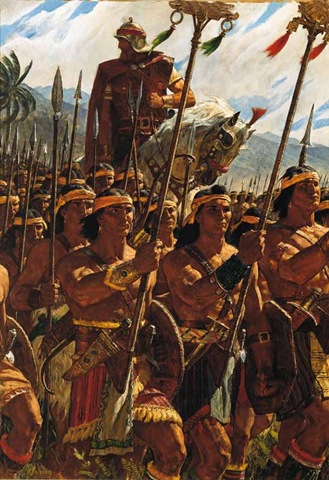
Accordingly, the ancient Nephites averred they were justified in defending their families and religion from foreign aggression (Alma 43:46-47) but held the pacifist Anti-Nephi-Lehies up as having a much higher standard: “For behold, they had rather sacrifice their lives than even to take the life of their enemy . . . And now behold I say unto you, has there been so great love in all the land? Behold, I say unto you, Nay, there has not, even among the Nephites. For behold, they would take up arms against their brethren; they would not suffer themselves to be slain” (Alma 26:32-34). The Nephites never lived this higher law, but when righteous they strove to suffer multiple offenses before retaliating, as Hugh Nibley explained about Captain Moroni and the futility of preemptive war. And, finally, whenever the Nephites ignored even the lower law of not giving the first offense they were swept before their enemies (as in Morm. 4:4).
I’ve thought about all of this often since September 2001. My belief in scriptures like these made me initially wary of and eventually completely opposed to invading Iraq specifically and the Bush doctrine in general. The potential threat from Iraq did not warrant the level of violence and disruption we inflicted upon that nation, and thus I have for years seen ending the Iraq War and beginning to make restitution for our national sin as one of our country’s highest moral imperatives. Ending the Iraq War and shifting the tenor of international diplomacy from one threatening violence to one eschewing it as much as possible is the President's greatest foreign affairs victory, and one that has made him worthy of his Nobel Peace Prize that so many thought premature; the point was that the shift in global feeling between Bush and Obama was palpable, and had a real ripple effect that's still going. On the other hand, Governor Romney’s comments that Guantánamo ought to be doubled and, later, that the rapid drawdown in Iraq was tragic, even when taken in context, are lamentable and seem to place his worldview on the morality of war completely outside my own.
Even in October 2001, when the U.S. launched the first missile strikes into Afghanistan during an LDS general conference, my first thought was not about al-Qaeda but about Lachoneus. As the news was breaking, President Hinckley stood at the pulpit, explicitly comparing the September 11th terrorists with the Gadianton robbers. Lachoneus and his people faced a force of robbers that threatened to completely annihilate them—more than al-Qaeda or the Taliban could ever plausibly threaten the U.S. with. Yet when the people prodded his chief general Gidgiddoni to “pray unto the Lord” for his blessing and go attack the robbers in their mountain strongholds, he responded, “The Lord forbid; for if we should go up against them the Lord would deliver us into their hands; therefore we will prepare ourselves in the center of our lands, and we will gather all our armies together, and we will not go against them, but we will wait till they shall come against us; therefore as the Lord liveth, if we do this he will deliver them into our hands” (3 Ne. 3:20-21). Thus I wondered if the complete overthrow of the Taliban and long-term nation building in the mountains of Afghanistan was really the right choice. During that address President Hinckley said that “the terrible forces of evil must be confronted and held accountable for their actions,” but he also warned that “now we are off on another dangerous undertaking, the unfolding of which and the end thereof we do not know.” Overthrowing the Taliban in order to scramble al-Qaeda in Asia seemed a justifiable mission, but I wondered even then if the same results couldn’t have been achieved with a much smaller hammer. Unfortunately I feel my misgivings have played out as Afghanistan has become the longest war in American history—one Governor Romney wants to continue indefinitely. President Obama, unlike Bush and Romney, conceived a much more nimble strategy and eventually killed bin Laden and other al-Qaeda leaders throughout the region while reducing troop numbers; we can judge the scope of this accomplishment by remembering that Gadianton himself was never caught.
So, to summarize so far, my religion causes me to believe that pacifism is better than belligerence, and that when we do fight it should only be after several offenses and only in self-defense. But to renounce war and proclaim peace means, I think, something even more than that: that we should seek to be our brothers’ keeper and strive for the end of all violence throughout the world.
How do we do it? As far as our Church and other churches are concerned it means working to spread the gospel throughout the world: when the Nephites were faced with a dangerous border community that might incite the Lamanites to violence, their record states: “And now, as the preaching of the word had a great tendency to lead the people to do that which was just—yea, it had had more powerful effect upon the minds of the people than the sword, or anything else, which had happened unto them—therefore Alma thought it was expedient that they should try the virtue of the word of God” (Alma 31:5). Roughly fifty years later, the righteous Lamanites were faced with the growth of the Gadianton robbers among them and responded with a mixed campaign of military strikes and proselytizing: “And they did preach the word of God among the more wicked part of them, insomuch that this band of robbers was utterly destroyed from among the Lamanites” (Hel. 6:37). So much fighting has been carried out in the name of religion, it’s good to remember that religion can also be the primary cure.
As far as our government and other governments are concerned it means robust diplomacy aimed primarily to curb tyranny, violence between states and communities, violation of international law, and human rights abuses. It means we have a responsibility to stand up for those who are most defenseless—like the Nephites who suffered Lamanite aggression for protecting the Anti-Nephi-Lehies (Alma 28:2 calls it the most “tremendous battle” in their entire history)—and intervene as much as our resources permit in cases of genocide or large-scale oppression—including, at present, possibly Syria and certainly Palestine, where the United States’ opposition to recognizing Palestinian statehood in the UN is one of the low points of the Obama administration’s foreign policy record. I feel it is our duty to pay the most attention to those who are most defenseless, and any nation, like Palestine, without a state certainly falls in that category. This, by the way, is an example of where my Mormon beliefs cause me to take a position—that the United States needs to support a measured but determined process for Palestinian statehood—that neither American political party has ever really embraced.
But I’m not suggesting America needs to invade every country with a popular insurrection or throw its military might around unnecessarily. The responsibility, real or imagined, to be the world’s policeman can overstretch even the world’s largest military, and one often makes the mistake of sending forces into areas where our intervention isn’t necessary, the largest recent examples being Vietnam and, as mentioned, Iraq. Any Commander-in-Chief this soon after Bush will be wary of that, and President Obama’s response to Libya seemed measured but effective, using technology to assist rebels fighting a superiorly armed despot without endangering the lives of American ground forces. Of course, it can be argued that this assistance came only after Gaddafi’s position became untenable and that U.S. support for the dictators in Egypt and Tunisia (and Syria) lasted far too long—and should never have existed in the first place; supporting a regime that does not have its people’s best interest at heart just because it supports American economic interests is not a tenable position: we should be just as concerned for each and every citizen of Saudi Arabia, Pakistan, or Iraq as of the United States.
This raises a second point that has dogged the U.S. since at least the Mexican-American War: that our own foreign policy should not have a direct negative impact—such as when our unmanned drones kill civilians then name them posthumously as “enemy combatants”—or, as much as possible, any negative externalities. This is most obvious with military interventions but can come from other sources: NAFTA, for instance, was intended to increase efficiency in North America by reducing trade barriers—Economics 101—but it had the negative affect of underselling many Mexican farmers, especially corn farmers, putting them out of work, and forcing many of them to come, undocumented, to America to work in our farms, causing personal strain on them and their families specifically and also on Mexico’s economy as a whole. Latin America unfortunately has many other examples, as the conservative regimes the U.S. and the CIA propped up during the Cold War often turned out to be some of the worst human rights violators in the world, decimating populations and economies in El Salvador, Nicaragua, Chile, the Dominican Republic, Guatemala, and other countries. Other instances—such as arming the anti-Soviet rebels who became the Afghan Taliban—have come back to haunt us as well.
War is arguably the greatest evil that man can perpetrate on man. A true statesman will do everything in his power to avoid it—including communicating with his enemies (as Captain Moroni did)—and would never delegate that authority to even his allies. Thus the friction between the Obama administration and Hamid Karzai or Nouri al-Maliki is actually encouraging, while Governor Romney’s close personal relationship with Benjamin Netanyahu is, more than anything, troubling. In his speech on foreign policy Monday Romney said that “the world must never see any daylight between” the U.S. and Israel. Romney can’t seriously expect to defer to Netanyahu on Middle East policy—particularly not after the latter’s performance at the United Nations. There must be daylight there, and I think most Republicans would agree with that.
More importantly—because it’s more possible, if not practical—someone who wants to renounce war and proclaim peace should not attempt to enlarge what is already by far the largest military force in the history of the world. Romney has consistently vowed to enlarge the military, but it seems more in deference to his financial backers than to wise national policy. In Monday’s speech Romney said, “I’ll roll back President Obama’s deep and arbitrary cuts to our national defense that would devastate our military.” As David Ignatius wrote, “that’s pure demagogy. One of Obama’s more thoughtful efforts was the defense budget guidance announced last January in which all the service chiefs agreed to balanced reductions in forces—including agreement by the Army and Marine Corps to significant cuts in ground forces on the understanding that we won’t be fighting more wars like Iraq and Afghanistan in the near future. Romney should credit that kind of careful, consensus planning rather than trashing it.” Similarly, Romney's aggression toward Russia and opposition to nuclear draw-down--a major theme of Obama's Russian relations--seems geared toward increasing the possibility of war rather than decreasing it--and was cited by Putin as strengthening his resolve against NATO's European missile network (and possibly its announced withdrawal from Nunn-Lugar).
Indeed, in foreign policy as in everything else, the current President is nothing if not a careful, thoughtful pragmatist. His evolving firmness with China evinces this, and it is evident through his and Secretary Clinton’s dealings throughout the world, even up to the lifting of international banking restrictions on Myanmar a few days ago. (Hillary Clinton, in fact, has been a stellar Secretary of State, actually reminding me of President Hinckley in her vivacity and record-breaking travels; she'll be missed next year no matter who wins the election.) I quite appreciate Jamie Zvirzdin’s evaluation of the President’s foreign policy successes and failures that was reposted on Mormons for Obama in August: “Even [Obama’s] supposed failures in foreign policy reflect good thinking in my mind.”
I’ve basically talked about war and not even touched on aid, which is actually just as big an issue, if not bigger; many more people live in poverty than in conflict zones, after all. I might get back into my beliefs here next time as I discuss how Mormonism influences my beliefs about economics, but suffice it now to quote Doctrine & Covenants 104:17-18:
“For the earth is full, and there is enough and to spare; yea, I prepared all things, and have given unto the children of men to be agents unto themselves. Therefore, if any man shall take of the abundance which I have made, and impart not his portion, according to the law of my gospel, unto the poor and the needy, he shall, with the wicked, lift up his eyes in hell, being in torment.”
“For of him unto whom much is given much is required” (D&C 82:3), something as true of nations as of individuals. If the Americas are truly a promised land that have been blessed beyond proportion, then we must use that blessing to eradicate poverty throughout the Americas and the rest of the world. It’s a process that might not be complete until the end of the millennium, but all the more reason for starting now. And it will take a mixture of individuals, organizations, and governments to accomplish it; without any one of these three it will be impossible. (One notable example of these coming together is the Half the Sky movement to empower women and girls in developing nations.)
So that’s roughly how my Mormonism influences my thoughts on how nations and states should interact, and the United States’ specific responsibilities. By and large my understanding of these doctrines causes me to support the Democratic party in foreign policy matters: even before getting down to brass tacks, Republicans often seem to place too much emphasis on American exceptionalism over global equality, which is where I feel the scriptures’ emphasis lies (as in 1 Ne. 17:32-36, 2 Ne. 29:7, and 2 Ne. 30:8), and hence feel justified in throwing our country’s weight around more broadly and dangerously than appropriate (and, Republican readers, I’m here thinking of Bush, Cheney, Romney, and Rice—not you). In contrast, the scriptures cause me to believe that completely unfettered self-interest is damaging for society at any level. Ayn Rand, Machiavelli, and Korihor all stand, each in their way, equally in stark contrast to the gospel of Jesus Christ. Zion has always been about all of society, not just the individual, about putting the interests of others above your own. Foreign policy reflects how nations of individuals navigate this on a global scale. At its heart, every decision should ask if this choice, this policy is as beneficial for the whole global community as it is for our own self-interest (speaking of national self-interest, let alone individual politicians’ self-interest). And if not, perhaps it’s time to rethink that policy and what it means to be sent by God to this earth, which is everyone’s second estate, at this time, with these blessings and these responsibilities that God has given us today.
Republican vs. Democratic Mormons - Another View
I don’t want to criticize Sister Lewis in any way; I think she was eloquent and concise in her analysis. And she has an obvious point. We LDS Democrats appreciate her standing up for our devotion to our faith. However, I’d like to propose another way of looking at the problem. (Disclaimer: The ideas presented here are certainly not original with me, but are based on the insights of others.)
One problem with the agency vs. love analysis is this: Except for the rare libertarian like Ron Paul, the stated ideal of conservatism for limited government conflicts with how conservatives actually govern. In Utah, we have “Zion Curtains” in restaurants to prevent the unwary soul from perhaps laying eyes on a bottle of booze. There’s the trampling of our constitutional right to privacy under the Patriot Act, and of course, the repeated attempts to legislate morality. I could go on, but you get the idea. The power and reach of the federal government, including spending, expanded at a greater rate under George W. Bush than any time since World War II.
The other problem is this: If the choice among Mormons was between love and agency, the Democrats would be in the majority. Christ said the first and greatest commandment was to love the Lord with all your heart and your neighbor as yourself. Call me an optimist, but unless it’s a deep, subconscious thing, I would argue most Mormon Republicans would not hesitate for a moment in proclaiming love as the first commandment.
So what’s the alternative? I think there is another way of characterizing the conservative mindset. Their core value is not limited government. Conservatives believe in authority. They value strong principles more than pragmatism. They’re the classic strict father type.
Ask a conservative what they admire about Ronald Reagan, and the gut reaction won’t be his policies. Instead, they will say he was a strong leader who stood up for his principles. Ask the same conservative why they dislike Jimmy Carter, and the gut reaction will be: He was a weak, vacillating leader. It will be a rare conservative who would be able to cite one thing about Carter’s actual policies that they disagreed with.
I think this mindset is behind the oft-repeated phrase by conservatives: America isn’t a democracy, it’s a republic. Translation: The “mob” can’t be trusted to rule our country; we need to entrust the government to authoritarian figures. And I think we can understand the underlying attitude of conservatives towards the poor by picturing the strict, authoritarian father who boots his 25-year old son out of the house so he will learn responsibility. Listen closely and there is a paternalistic undercurrent behind proclamations by conservatives that unemployment insurance encourages laziness.
So, as a counterpoint, what are Democrats? Maybe the best analogy is the nurturing parent type, who works to give her children the life’s lessons they need and a firm foundation to stand on, but encourages them to think for themselves and choose their own path in life. She is the one who truly believes in free agency. The nurturing parent wouldn’t have a problem with that 25 year-old kid living at home, as long as they were working towards a goal they were passionate about. As much as this nurturing mom loves her own children, she would cringe at the idea that someone else’s child should suffer or not have a chance to grow up and achieve their dreams; hence, the nurturing mom’s passion for communitarian responsibility, or “the village”, as Hillary Clinton put it.
This model explains the difference between women and men in party affiliation; women tend more to the nurturing parent side. It also explains the greater tolerance of progressive parents toward children who perhaps don’t follow the exact path their parents wished them to follow.
Mainly, I think this explains the preference of active Latter-day Saints for the Republican Party. We’re conditioned to have respect for authority and to have strong beliefs in basic principles. The problem: This mindset is meant only to apply to the Gospel. We’re not supposed to give the same reverence to the philosophies of men that we give to the word of God. That’s idolatry. The Gospel provides a solid foundation for us to stand on while we think and act for ourselves on other issues. The Brethren could not have been more clear on this over the years, but the mindset of the average Latter-day Saint has a hard time dealing with the truth that the Lord actually wants us to think and act for ourselves on political issues.
Convincing good Latter-day Saints to give progressive politics a chance is a challenge; I’m hoping there are a few kernels of insight here that might help us in the battle.

Mormons for Obama National Conference Call: Update
Mormons for Obama hosted a national conference call for LDS voters this past Tuesday evening. We heard some terrific reports, had a great conversation about the presidential race and key senate campaigns, and unveiled our plan of action for the final four weeks. Our greatest strength as "Mormons for Obama" comes from our ability to talk with fellow Latter-day Saints and others of strong religious belief about how President Obama represents our values in his policies and personal life. These neighbor-to-neighbor, friend-to-friend conversations are what really makes the difference, and are absolutely crucial to winning this election on the ground. For this reason, our three main initiatives for the final stretch are:
1. Flooding Nevada and Colorado with LDS volunteers. Folks in UT are getting in touch with the Utah Obama office for phonebanking & canvassing opportunities in NV & CO. People in Nevada, Colorado, (and "Little Provo" in VA) are picking out heavily LDS neighborhoods, finding a friend to canvass with them, and getting in touch with their local Obama office to get a list of targeted doors in those neighborhoods. (We are NOT using ward lists in any way, shape, or form.) If you want to participate or have questions, subscribe to our newsletter or ask in the comments. We also need a snazzy name for this initiative, akin to the "Great Schlep" from 2008, but Mormon-y.
2. Getting even more heavily involved in volunteering with the local Obama for America neighborhood teams. We're finding our local offices and participating in local volunteering opportunities. We're sporting any Mormons for Obama gear we own and otherwise letting our fellow Obama supporters know that at least some Mormons stand with them.
3. Talking to friends and family who live in swing states and are either on the fence or supporting President Obama. We're sharing the President's record with those who are on the fence. We're getting out the vote (early if at all possible) with those who know they want four more years of President Obama in the White House!
Two major themes that came out of Tuesday night's call were the importance of letting our views be known so other Latter-day Saints no longer feel like "the only LDS Democrat" or "the only LDS Obama supporter" and the terrific volunteer skills we already possess & our ability to have an outsized impact as we get to work. We can, and we will, make a crucial difference as we get President Obama elected for another four years!
We can, in short, be these elves.
[youtube=http://www.youtube.com/watch?v=kl5tG3fRZhk]
Mormon Dems: The Case Against Mitt Romney

Post by Rob T.
The website Mormon Dems has long piece laying out the reasons not to vote for Gov. Romney this November. I encourage you to read the whole thing here for the meat of the argument, but here are some key quotes:
"While I admire Romney’s dedicated unpaid service in my church as a bishop and stake president, believe that he is a good family man who also cares deeply about our country, and am thrilled by Romney’s ascension to the GOP nomination in this Mormon moment, I am confident that he is the wrong person for the job of President of the United States."
"I recognize that many politicians shift their positions from time to time, but cannot think of any politician as well-known as Governor Romney who has gone through such seismic political shifts. These shifts are disconcerting not only to me, but also to many GOP primary voters who wondered whether Romney was as “severely conservative” as he said he was. Governor Romney’s GOP Primary opponents were often frustrated by Romney’s flip-flops and had difficulty cornering him on any particular issue. How do we know how Romney would govern as President? While I suspect Governor Romney may not be as conservative as he appeared in order to clinch the nomination, no one really knows. This is why I do not find Romney to be trustworthy as a politician."
"While Governor Romney’s candidacy is exciting for Mormons and has done a tremendous service for our church by helping to bring it out of obscurity and to generate a national and global conversation about Mormonism, a Romney presidency would be wrong for our country in many ways. Even if Romney is more moderate than he seems, many of his party members in Congress are 'severely conservative' and would put tremendous pressure on him to pass right-wing legislation and appoint right-wing officials and judges. For these reasons and others, I cannot support Mitt Romney for President."
The Case Against Mitt Romney
Mitt Romney’s nomination as the 2012 Republican candidate for President is an important and historical moment for me and many other members of the Church of Jesus Christ of Latter-day Saints across the U.S. and the world. A thick glass ceiling was shattered when Romney, a prominent member of my faith, overcame anti-Mormon bigotry prevalent in parts of the Republican primary electorate to clinch the GOP nomination. During the past twelve years we have been witnesses to a triumph over a wide array of social prejudices in American politics with the nomination of Senator Joseph Lieberman, who is Jewish, as the Democratic Party’s vice presidential candidate in 2000, Hillary Rodham Clinton’s historic run as the first serious female contender for the White House in 2008, and Barack Obama’s election as the country’s first African-American president. We may very well have a Mormon as our President starting next January. While I admire Romney’s dedicated unpaid service in my church as a bishop and stake president, believe that he is a good family man who also cares deeply about our country, and am thrilled by Romney’s ascension to the GOP nomination in this Mormon moment, I am confident that he is the wrong person for the job of President of the United States.
Mormons for Obama (Again!)

KSL News in Utah did an interview with BYU students Hannah Wheelwright and Ben Ader - once again making the point that many Mormons will vote for Obama in November. And of course, Hannah is sporting some really nice bumper stickers on her computer. This kind of publicity and dedication is encouraging and energizing - especially to find this reporting on a Utah news station that is operated by Bonneville Communications. So let's make one final push for November! See the article here on KSL.Com, and watch Hannah's interview at that link as well. Additionally, refer to Hannah's article, "Anxiously Engaged" to learn how you can get involved!

Talking Politics and Religion
 The Book of Mormon teaches, in many places, the danger of contentions that are of the devil: the moment a political discussion gets angry or mean-spirited, that discussion is doing more harm than good. Not all contention is bad, though, at least according to the Book of Mormon. We read in Alma 2:5 that the righteous people of Alma engaged in passionate debate about their laws, debates described as "wonderful contentions." Talking politics, it seems, can and should be a positive experience.
The old adage "never talk politics or religion in polite company" is abysmally horrible advice. First off, the entire missionary program of the Church directly contradicts the latter half of that pithy phrase: we send our young people out with the express purpose of talking religion in polite company for 18-24 months. And then we ask them to continue doing it forever after--"every member a missionary." Apparently the Lord Himself would prefer we not follow that advice.
Secondly, if we can't discuss the most important issues (politics and religion) among polite company, we avoid practicing the very skill that is required to bring people closer to Christ. In addition, we neglect our responsibility to become the type of citizenry that is able to discuss and decide and debate. We will never be that people until we start trying to become that people: through deliberation we become better able to deliberate. Finally, when we ban politics and religion from polite company, we we are overtly relegating them to impolite company.
And then we wonder why politics is sometimes so nasty.
A democracy is only functional if We the People make it so. And, if we ignore the better Picards of our nature and decline to "make it so," then we're leaving the biggest decisions of our country in the hands of folks who are more interested in turning a profit, winning an advancement, or earning a raise.
And we can't blame them: we've handed them the keys to the country and tuned out.
Read more
October 07, 2012
Try Though I May, I Can't Understand Liberalism. Can You Explain It To Me?
A friend recently asked me to explain my political ideology to her. She said that try though she may, she cannot understand liberalism or why anyone would support President Obama. I have the utmost respect for this particular friend; I believe her request was absolutely genuine. So I tried my best to explain my beliefs to her. Here is what I wrote:
Hello,
Sorry it has taken me a few days to reply to this. I wanted to have a decent block of time to to attempt to answer your question. First, I don't consider myself the spokesperson for liberalism or for the Democratic Party or for Obama supporters, although I'm proud to be part of all three groups. I am not well enough informed on ALL the issues to be the voice of our ideology. Gerald is far more knowledgeable than I am because he is a self-professed "political junkie." However, you did not ask him; you asked me. So I'll try my best to tell you what I know and believe, because you asked. I should also say that as baffled as you are by liberalism, I am equally baffled by conservatism. I truly don't understand how regular people (normal middle class Americans) could possibly support the proposed policies of Governor Romney. So you and I have that in common. We are both mystified by the other's beliefs.
When I think about politics, I tend to separate issues into four main groups: domestic issues, foreign policy, economic issues, and social concerns. These overlap, of course, but my brain does better when I consider them individually. Regarding domestic policies, unlike conservatives, I believe government should have a role. While it would be great if all people had family members and churches to help them, that is not the case. It is our responsibility to help the needy and the underprivileged. In a country as prosperous as ours, it is an atrocity for anyone ever to go to bed hungry or without adequate shelter. We are the only developed nation in the world where people have to be frightened of their medical bills. That is not okay with me. Healthcare is a basic human right, just like food and shelter. Conservatives like to use the buzzword "entitlements," as though it is a terrible thing. It isn't. As Heavenly Father's children, we are indeed entitled to food, shelter, and healthcare.
This crosses over into social issues. Conservatives often have disdain for welfare abuse and, therefore, oppose welfare and all social programs. As long as there is aid for the needy, some WILL abuse the system. That's because people have their agency. And that's between them and God. It's not my issue. But to throw out welfare (and other social programs that aid the poor) because some people abuse it is beyond ridiculous. Pure love demands that we take care of our citizens. It is an embarrassment to our great nation when we let its citizens (and their children) starve. As for other social issues, there are many. I will address some of the most commonly disputed.
The right of women to make their own healthcare choices, including safe abortion, is always a huge issue. For sure, I'm no fan of abortion. It is the saddest thing. I can't think of a circumstance other than to save my own life (so I may continue to be a mother to my already-born children) that would cause me to choose to have an abortion. However, it is not my right to force my viewpoint upon all women. Instead, I would fund programs to educate women about effective contraception and make it available to all. I would make sex education more comprehensive in schools, rather than abstinence-only curricula, which is both naive and ineffective. I would continue to fund programs for single mothers, so they have a chance for a strong education, giving them the opportunity to provide a decent life for their children. I would fund solid, professional counseling for young pregnant women, so they might choose to continue their pregnancies and give life to their babies, without it defeating them and ruining their own lives. But in the end, I am still pro-choice. The right to safe, legal abortion in the first trimester must be protected.
Gun control and capital punishment are other topics of interest that tend to divide liberals from conservatives. I favor the strictest gun control laws possible under the U.S. Constitution. Allowing folks to go out and buy a hand gun that is designed with the single purpose to kill people, and to do so without proper documentation and without any wait time, is possibly the most irresponsible act I can imagine. Capital punishment, though not currently in the forefront of political discussion, is my personal "soap box" issue, so I won't leave it out. We are the only developed nation in the world that still kills its own citizens. How very sad. There is no place for this barbaric practice, which dehumanizes society and disregards and disrespects us like nothing else.
As for foreign policy, I believe that war must always be our very last resort. Neither war that was instigated during the Bush years (and that we are still trying to escape but paying for nonetheless) was justified. Republicans complain about the deficit. I have little sympathy when it's clear that by far the greatest majority of that debt was used to fund two ridiculous wars that we never belonged in. I'm not a pure pacifist. If someone comes through my door and tries to hurt my babies, I'm pretty sure I'll do anything to protect them. But fighting a war in Iraq over oil was both unjustified and immoral. We need to coexist peacefully with other countries, not present a "tough guy" attitude that repulses people. Arrogance never accomplishes anything.
Regarding economics, I don't claim to be an expert. However, I know for sure that everyone needs to pay his or her fair share of taxes to fund the programs I discussed above and also so we may have fire and police protection, quality education, good roads, etc. Governor Romney has been slow to produce his tax returns, but if I remember correctly, he finally released 2011, which showed he paid around 14% in income tax and Social Security. Gerald and I, who earn far less, paid a higher percentage. This is NOT okay with me. Not at all. Tax cuts for the wealthiest 1% only help the wealthiest 1%. The burden is repeatedly placed on the middle class. The only way to economic stability and prosperity is to build a strong middle class. And that's what the President is trying to do, though he finds himself blocked by the GOP Congress over and over. I don't agree with every policy of President Obama, but I'm proud of what he has accomplished. He was left with a giant mess after eight years of the Bush administration. My hope is that he will be reelected and that congress will be willing to work with him toward economic recovery. When he was elected in 2008, many Republicans in congress said it was their #1 goal to make him a one-term president. If that was their #1 goal, no wonder they refused to unite with him to solve problems. Once he is reelected, that can no longer be their #1 goal, obviously. So perhaps they will be able to put the needs of the county ahead of their hatred for the President and get down to work.
I really hope this was helpful to you. For what it's worth, I love you and care about you as a friend, and differing politics could never change that. So many of my best friends are conservatives. I think it's a demonstration of grace and maturity when people with different views can respect each other and appreciate each other for the intelligent, worthy individuals they are. Those who can't do that truly miss out.