

LDS Dems-Idaho Interview: Travis Manning for Idaho Senate Seat 12
This interview is part of a series of interviews of Democrat candidates across the state from varying religious backgrounds. LDS Dems-Idaho recently interviewed Travis Manning about his current run for Idaho House of Representatives Seat 10A. We encourage you to learn more about him at www.votetravismanning.com.
This interview was conducted by Jon Young, an LDS Democrat living in Boise, ID.

10 Reasons I Became a Democrat
When I marched down to the city office building in Brigham City to change my party affiliation, I couldn't help reflect on how much I had changed in twenty years. How is it that someone goes from being a Rush Limbaugh listening, fourth generation Republican, to becoming a member of the Democratic Party?
Read more
Mormon Church on Citizenship and Founding Fathers’ Intent
I think it’s safe to say I am very politically active in large part because of my upbringing in the Mormon Faith. My own father, who is a constitutional law professor, probably took as much interest in the Constitution as he did because of the importance placed on the document in our faith.
It is an interesting time for the Mormon Church to speak up about citizenship in a recent statement released to the public. I found the emphasis on religious freedom particularly timely. It’s an issue gripping and dividing our nation as we speak. While the Church takes no position on any individual bill right now, particularly the Arizona Bill vetoed by Governor Jan Brewer, this statement goes to lengths to emphasize the importance of not only religious freedom, but also for the need of the people of this nation to be a religious people to maintain freedom itself. No doubt Ayn Rand would totally disagree… but I digress.


Hope for a better world
I've come to wonder how, in recent years, such a concept as hope has managed to become a polarizing buzzword in the modern political landscape. How a basic human and Christian virtue has become the subject of mockery.
In Ether 12:4, Moroni wrote that those who believe in God may with surety hope for a better world. Sure and hope are not words that are often thrown together, but is there any greater promise that we can hope for in this life than a better world?
Read more
State Capitals Are Key to 2014 Election
 Most Americans claim they are tired of bitter partisanship and Congressional gridlock in Washington. The non-stop manufactured crises, including the show-downs over the federal budget and debt ceiling, the more than 40 House votes to repeal the Affordable Care Act, and the unprecedented use of the filibuster in the Senate to block even routine executive and judicial appointments, are just some of the ways politicians have log-jammed our democracy. Last October’s unpopular government shut down led to the furlough of nearly 1 million workers, while another million were compelled to work without pay. Any astute observer of American politics knows that one of the primary reasons for this Congressional dissonance is hyper-partisan redistricting, or gerrymandering.
Most Americans support raising the minimum wage, comprehensive immigration reform, and universal background checks on gun buyers. Americans do not want subsidies for oil companies and tax breaks for corporate jet owners. And Americans are in favor of balanced deficit reduction that includes both new revenues and spending cuts. Yet, partisan gerrymandering is why these and many other highly popular proposed reforms have no chance of passing in the current Congress.
How becoming a liberal Mormon (and not hiding it) is essential missionary work
 12 Let no man despise thy youth; but be thou an example of the believers, in word, in conversation, in charity, in spirit, in faith, in purity.
1 Timothy 4:12
The Church of Jesus Christ of Latter-day Saints can depend on left-leaning members to draw a growing demographic, which would otherwise be repulsed by organized religion, to learn about and even accept the Restored Gospel.
Read more
The GOP Left Me
Several months ago, when a friend invited me to join the “Mormon Liberals” Facebook group, my wife asked me, "Are you going to join?" I looked at her and said, “I’m not a liberal.” She looked at me and said, “Yes, you are.” And I was at a loss for words. They say your wife knows you better than you know yourself, but I didn’t think this was actually the case until I realized -- she was absolutely correct.
Read more
LDS Dems-Idaho Interview: Holli Woodings for Secretary of State
This interview was conducted by Jon Young, an LDS Democrat living in Boise, ID.
JON: Holli, Thank you so much; it's an honor to speak with you. You've recently announced your run for Idaho secretary of state. Many people may not be very familiar with the position. I honestly never heard of it until a bright orange card came in the mail asking me to send an annual report to the Secretary of State, Ben Ysursa for a Limited Liability Corporation (LLC) I used for technology contracting. That was probably the easiest report I ever sent: just go online and let Idaho know I'm still in business. What other responsibilities fall under the Idaho secretary of state?
HOLLI: Hi Jon, thank you for thinking to include me! I'm excited for your caucus as I have many LDS friends who think they're the only ones who identify politically as a Democrat rather than a Republican, so it's great to have an active, visible group to show them otherwise.
Your question is great because a lot of us respond to our orange card each year, and it's so easy to keep our business status up-to-date with the secretary of state's office. In addition to business filings, the secretary of state administers elections, a position that I see as one of the most important functions of the office - to keep voting in Idaho open and accessible to all eligible voters. The secretary also holds a seat on the Land Board, which oversees the management of our state endowment lands in order to fund education. Administratively, the office oversees use of the Great Seal of Idaho, licenses notaries public, administers the Idaho Health Care Directive Registry, issues trademarks, and enforces the campaign finance reporting.
JON: You said “keep voting in Idaho open and accessible.” Do you see any current or future problems to correct with our voting system in Idaho?
HOLLI: I see the key word as "keep." We actually have a great elections system here in Idaho and it's important that we keep it that way. There are opportunities to allow greater opportunities to register to vote, such as DMV registration or online registration that will help the homebound or those serving overseas.
JON: Concerning campaign finance, when we voted on Propositions 1, 2, & 3, aka "The Luna Laws," a few years back, I was disturbed to hear New York City Mayor Michael Bloomberg had donated $200,000 to a group supporting those measures. What, if anything, can you do to discourage or expose external donors whose interests likely do not align with the needs of Idahoans?
HOLLI: The thing to remember is we wouldn't have even known about that contribution had our current secretary of state, Ben Ysursa, not been even handed in enforcing our campaign finance laws. The Sunshine Law was enacted by voter initiative in 1974 because Idahoans want to know where the money is coming from for campaigns and lobbyist expenditures. It's up to the secretary of state to enforce that law and is something I take seriously.
JON: Since the secretary of state oversees both voting and campaign finance in Idaho, we need someone who can avoid picking a side in partisan battles. How might you ensure your efforts are equal or fair?
HOLLI: By enforcing the law equally, regardless of which side of the issue an organization or individual represents, we can ensure fairness and accountability for all parties.
JON: Please relate a few experiences that have prepared you to serve as the Idaho secretary of state?
HOLLI: One of the best experiences to prepare me has been my position on the House State Affairs committee. This is where all legislation and rules put forth by the secretary of state's office are reviewed and either voted up or down. This role has given me the opportunity to become well versed in state election law, and allowed me to interact with our county elections officials in a meaningful way. Additionally, we review the rules of the office, such as records keeping and the Sunshine Law.
Outside of the legislature, I've registered both nonprofit organizations and LLCs, complied with Sunshine Law as a political candidate and as a lobbyist, and volunteered to help college students register to vote, all of which interface with the Secretary of State's office. The office has a fairly modest staff whose size is comparable to that of MetaGeek, the company my husband founded and we've grown over the past several years, so management of that size of office is something I'm very familiar with.
JON: You have some great experience that we need in a Secretary of State. To wrap up this interview, do you have any additional l thoughts to share with voters?
HOLLI: I want to thank you for the opportunity, Jon. The Secretary of State is such an important position in keeping our elections open and accessible for all eligible voters and promoting investment in our schools. It would be my honor to continue the legacy of fairness and serve as Idaho's next Secretary of State.
Democrats prefer democracy
“To me, the scariest voter is the uninformed voter.”
I can think of a few things more scary, Mike.
To me, the scariest voter is the voter that believes he deserves more say in how our country is run than his fellow citizens. They have a name for that: oligarchy. It sure ain’t democracy. One of the things that pushed me into being a Utah Democrat was hearing Republican delegates in 2005 call in to the Doug Wright show one afternoon explaining why they deserved more say in how the state was run than their clueless fellow citizens (especially if those citizens were registered Democrats). The arrogance of those people really shocked me. Rep. Noel makes it clear they haven’t repented.
These folks argue that it’s none of the public’s business how the Republican Party chooses their candidates. What arrogance. The taxpayer foots the bill for our elections; our system of electing our representatives belongs to the people, not to any political party.
While we’re talking uninformed voters, Mike: Which voter is more uninformed? The voter who is maybe a little superficial in how she investigates the candidates and issues, but remains open minded – or the voter who is so rigid in his ideology that his mind is completely closed to facts, evidence or any sort of rational argument that disagrees with his cherished beliefs? Neither of the above is ideal – but if I had to choose, I think we would be much better off with the first. Modern Republicans remind me of the old Mark Twain quote: “It ain’t what you don’t know that gets you in trouble. It’s what you know that ain’t so.”
The Utah Legislature in general, and the fact that we sent John Swallow to the AG’s office and Mike Lee to the US Senate, are irrefutable examples that the current system is not working for Utah.
Kudos to Senator Bramble for bucking the extremists in his party and trying to find a workable compromise that maybe, just maybe, will be a good solution that balances the rights of the public with the concerns of political activists.
Our Budget Responsibility
The complexities and drivers of the federal budget are vast and intimidating to understand. However, it is very difficult to have discussions about our federal deficits and national debt unless the process is first understood. I want to initiate this discussion to help readers understand our nation’s budgetary process and to foster more informed dialogue. Hopefully this explanation will dispel partisan rhetoric and break down unfounded talking points.
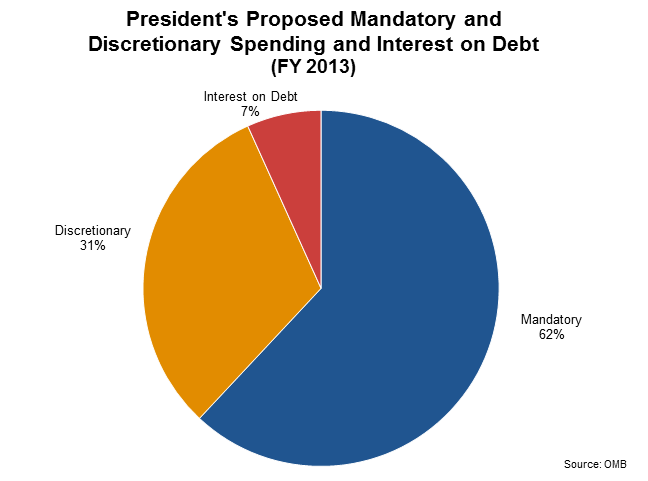 The Federal Budget: Our nation’s budget can be divided into two major segments; mandatory and discretionary spending. Mandatory spending is authorized by law and not subject to annual review or appropriations. This falls outside of the Executive Branch’s control as the President cannot unilaterally change laws and is incapable of creating spending bills per the Constitution. Mandatory spending is the largest part of our nation’s budget composed of entitlement programs like Medicare, Social Security, and welfare. Mandatory spending is also incredibly difficult to alter given complexities and integration with society.
Discretionary spending is subject to the budgetary process and controlled by the Executive Branch. Over half of our discretionary spending is allocated to the military and the other half is divided 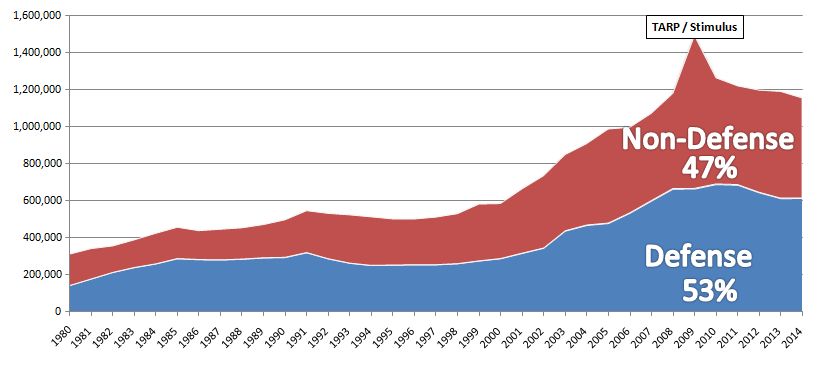 according to department need. Since the President maintains control of the discretionary budget he should be held accountable for increasing or decreasing spending. The current discretionary budget today is $1.1 trillion, slightly less than in 2008.
The Calendar: The federal government reports on a fiscal year outside of the calendar year. This is common for many corporations as fiscal years can be planned around inventory fluctuations or revenue patterns. Regardless of the reason, our national budget runs annually from October 1st to September 30th. All accounting procedures are completed shortly after the fiscal year closes and the Office of Management and Budget (OMB) compiles reports made available to the public.
The Basic Process: At the beginning of the year the President initiates the process by submitting a budget to Congress. The budget is typically provided the first week of February. Once Congress receives the budget they send it to the Congressional Budget Office (CBO), a nonpartisan organization, to evaluate assumptions and quantify changes. Once the CBO evaluates the budget a report is published for the public and Congress (typically in March). The House of Representatives then adds any additional amendments, and begins confirmation with the Senate.
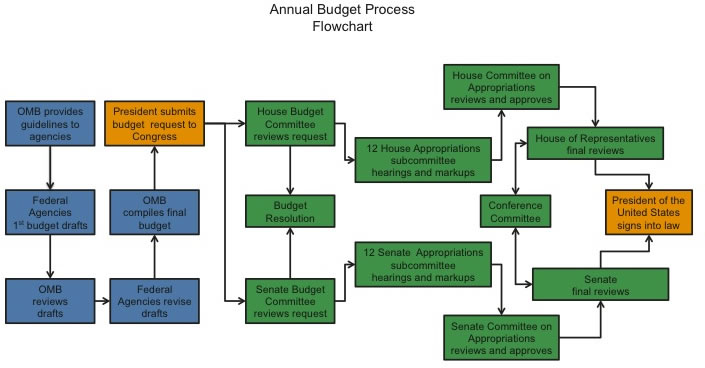 The Senate also receives the federal budget and may pass as submitted or add additional amendments. Discrepancies between chambers are typically worked in committee and once aligned the budget is voted on and sent back to the President’s desk. If the President aligns with the changes he signs the budget and it is implemented for the upcoming fiscal year. If the President is not aligned the budget is sent back to Congress for revision.
Continuing Resolutions: As we have seen in previous years the Senate, House, and Executive Branch might not agree on the budget. This lack of cooperation is typically pinned on the Chief Executive unfairly. However, there is a critical secondary process to keep the government operating without an annual budget; continuing resolutions (CR). A CR is passed by Congress and the President to continue operations at the same levels already agreed upon by a previous budget (a de facto budget). There are several CRs that need to pass to sustain spending in the Executive Branch. Simplified, there is a CR for every cabinet department (Defense, Homeland Security, Education, State, etc).
Do you remember when government shutdown in October of 2013? The beginning of the fiscal year (October 1st) came and our government did not have a completed budget or CR to authorize spending. With no authorization workers were furloughed and major departments of the Executive Branch closed. Again this only impacted the discretionary portion of total budget; mandatory spending is not reviewed annually and continued to be spent.
Avoid the Political Spin: No government branch has more control than another when it comes to passing the annual budget. I have often heard explanations arguing either the House or President controls the budget when results are favorable. For instance, when Clinton was president and the Republicans controlled the House, arguments were made justifying either branch's impact on the budget. Once the process is understood, it becomes clear that both branches need to work together to pass a budget.
This explanation might prompt readers to question the House’s role in spending per the Constitution. As directed by our founding document all spending bills must originate in the House. Bills are prelininary laws so new spending is first passed by the lower chamber. Once the bill becomes a mandatory law spending falls outside of the annual budgetary process.
A great example of the House’s constitutional power was witnessed when the Immigration Bill passed by the Senate in 2013. Once passed the bill was retained, waiting for the House to pass their own version and use reconciliation to put the bills together. If the Senate had sent their bill to the House, it would be immediately stamped unconstitutional and discarded.
My last admonishment for readers who have made it this far – know the actual budget and what is driving the annual deficit and the national debt. Although it seems easy to blame any one individual or party, it requires significant compromise and bipartisanship to change either mandatory or discretionary spending. Office of Management and Budget

February 27, 2014